
Quick links

Introduction
The Alliance for Water Stewardship Forum gathers the people shaping how companies, communities, and institutions manage shared water. The premise is that water is shared, so managing it responsibly means looking past your own fence line to the whole catchment and everyone who draws from it. That's what stewardship is, and it's the work we do at Waterplan, helping companies turn water risk into evidence and action. Forums like this one are where the evolving questions, concerns, and priorities of the people doing this work come into focus. Here are a few of the ideas that stayed with me from Edinburgh.
The people and the conversations
To give credit where it's due, the forum organizers put together an excellent program. The sessions were thoughtful, the discussions were practical, and the level of engagement and interaction across the room was high. That foundation made the rest possible, because as good as the formal sessions were, much of the real insight happened in the hallways. Seeing people in person, hearing what's on their minds both inside and outside the water world, is what puts the sessions in context. You often learn as much in the conversations between sessions as you do from the presentations themselves.
Stewardship in practice
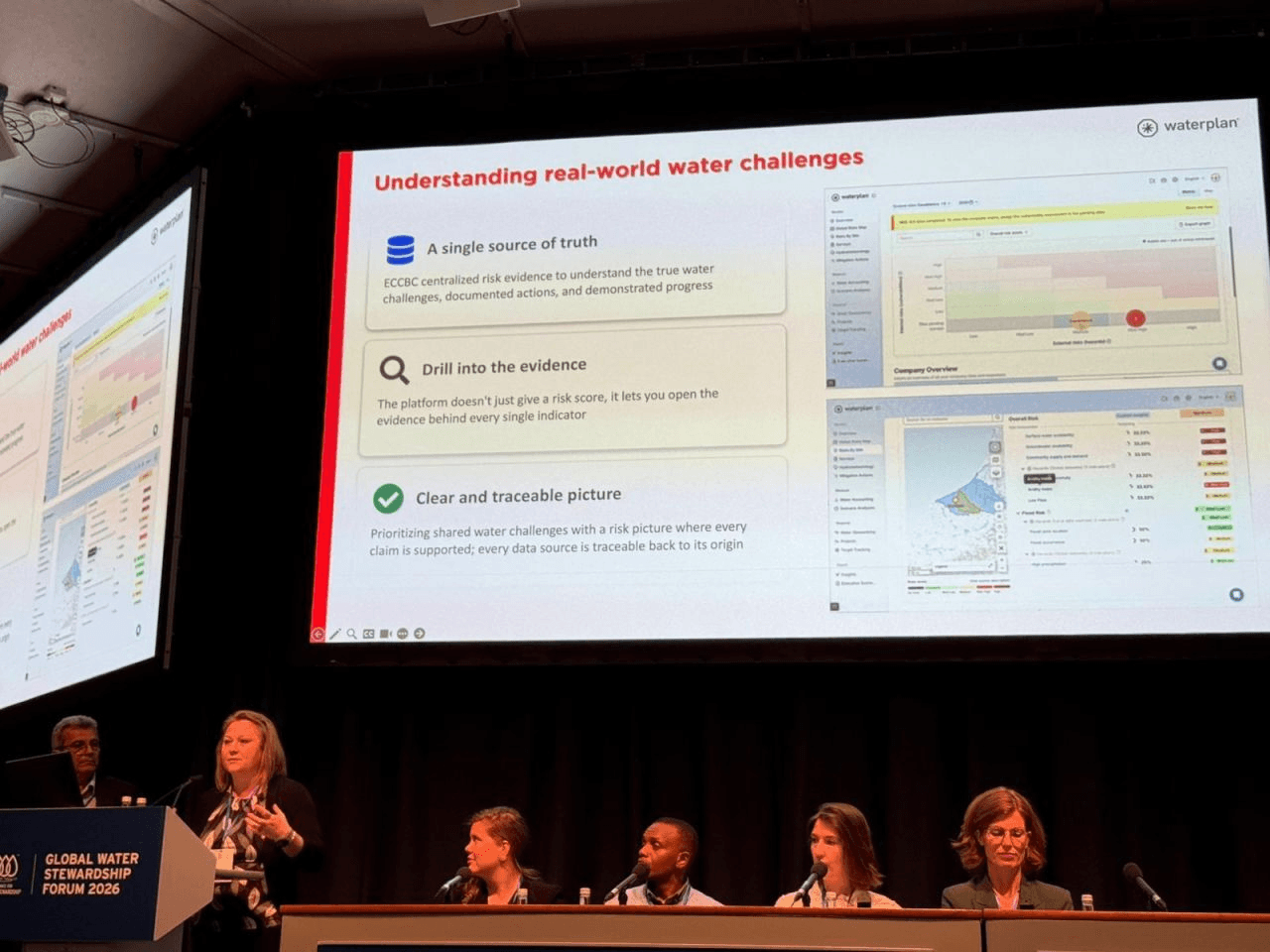
The highlight for me was co-presenting on the Water Stewardship Stories panel with Mr. Oussama Hasnaoui Amri of Equatorial Coca-Cola Bottling Company, on accelerating water stewardship with technology. We walked through ECCBC's journey in Morocco, moving from fragmented, site-driven data to a structured, auditable approach, and the launch of the Morocco Agribusiness Water Coalition. Real people solving real problems and turning individual risk into collective action. That's the part of this work that keeps me coming back.
Uncertainty looks a lot like risk
If there was one feeling running beneath the week's conversations, it was uncertainty: geopolitical, climatic, and institutional all at once. What struck me wasn't simply that people felt uncertain, but how differently they responded to it. Uncertainty and risk are closely related, and just as every organization has its own risk tolerance, people seem to have different thresholds for unpredictability and different views on what appropriate action should look like.
What resilience actually means
The word that kept surfacing was resilience. It's the obvious buzzword, and it's fair to be skeptical of any term that's suddenly everywhere. What's more interesting is that nobody means quite the same thing by it. When I asked people what it meant to them, some pointed to redundancy and hard infrastructure, others to adapting faster than a problem evolves, and others still to relationships and institutions that hold under stress.
One answer stuck with me. Resilience depends first on knowledge, on establishing the basic facts before reaching for models and projections. Where does the water come from? What's the storage volume, the recharge rate, the year-to-year variability? Who else relies on the same source? It's a useful corrective. Predictions have their place, but resilience built on speculation instead of facts can send you confidently in the wrong direction.
Another useful framing is that resilience isn't just about responding when something breaks. It's about recovering stronger, anticipating the next shock, and becoming better prepared with each cycle. It's an iterative practice, where trust and relationships matter just as much as the technical work. That contest over one word is worth paying attention to. A whole field reaching for the same term while meaning different things by it is a sign we're mid-shift, not settled.
That shift shows up in where water sits inside a business. The language has moved from corporate responsibility toward something more operational. The business case is being reframed. It's less about the savings from using less water, and more about whether there will be enough water to keep operating, secure supply, or justify permitting a new facility at all. That's a different conversation, and a more serious one.
AI: from "not in my backyard" to "how do we build responsibly?"
As an AI company, we naturally paid close attention to how artificial intelligence was discussed throughout the forum. The opinions remain polarized, but the conversation is evolving. The honest version of this debate isn't whether to stop the technology. Society is becoming increasingly compute-intensive, and AI also has enormous potential to help us understand and manage water more effectively.
The real question is structural: how do we site, permit, and build this infrastructure within real water constraints, and who decides the tradeoffs? Individual choices play a part, like the energy and water behind a needlessly long prompt, but that's the small end. The large end is how growth gets planned in places where water is already contested. That's a resilience question too, just at a different scale.
Stewardship doesn't stop at your operations
Companies increasingly recognize that a large share of their water footprint sits in the supply chain, not in their direct operations. This is the harder side of stewardship, because the catchments that matter most to a business are often ones it doesn't operate in directly. What companies lack is a consistent way to address it. Without international standardization, you get a patchwork, and where action is voluntary, some do a great deal and others very little. That brings us back to uncertainty. Shared water challenges are difficult to solve when everyone measures risk and acts differently.
More partners at the table, but where are the utilities?
It was encouraging to see more case studies and a wider view of public-private partnerships. Stewardship only works as a collective effort, so this is the right direction. However, a gap still remains. Utilities remain underrepresented despite being central to almost every long-term water solution. There was talk of building "cross-walks" between sectors, and that's the right instinct. We need to speak the same language and build the trust and relationships to back it.
Where this leaves us
If there was one thing the forum made clear, it's that uncertainty is now structural rather than temporary, and the field is still working out what to do about it. That's exactly why stewardship matters. It's the discipline of acting responsibly on a shared resource even when the future is unclear:
Know your risk today, grounded in facts and evidence.
Meet your stakeholders, and yes, that includes the utilities too often left out of the room.
Build resilience as an ongoing practice, not a one-time effort. The change isn't waiting for us to be ready.
Stewardship has always been about more than any single site. The forum reminds us that the work ahead is shared, and so is the resilience we're trying to build.
ブログ


Get insights, expert analysis and tips on measuring, reporting, and responding to water risk

